Russia largest country in world spans extremes geography history economy
Table of Contents
- Geographical Scope and Dimensions of the Largest Country in the World
- Comparison of Russia’s Land Area with the World’s Top 5 Largest Countries
- Territorial Divisions and Their Respective Sizes
- Geographical Extremes and Their Impact on Climate, Biodiversity, and Human Habitation
- Historical Evolution: How Russia Became the Largest Country
- Key Dynasties and Rulers Shaping Territorial Expansion
- Post-Soviet Territorial Changes and Geopolitical Shifts
- Siberia: The Backbone of Russia’s Eastern Expansion
- Urban Centers: From Trade Hubs to Expansionist Pillars
- Demographics: Population Distribution Across Russia’s Vast Territories
- Population Density and Urbanization: Russia Compared to Other Large Countries
- Challenges in Sparsely Populated Regions: Yakutia and Chukotka
- Federal District Disparities: Population and Economic Activity
- Migration Patterns: Internal and External Movements
- Economic and Resource Advantages of Russia’s Vast Territory
- Russia’s Natural Resources: Distribution and Economic Contribution
- Regional Economic Sectors: Industry Distribution and Government Policies
- Geopolitical Implications of Russia’s Vast Territorial Dominance
- Strategic Land Bridges and Maritime Corridors
- Arctic Sovereignty and Geopolitical Rivalries
- Cultural and Environmental Diversity Across Russia
- Ethnic Diversity and Geographical Concentrations
- Distinct Cultural Regions and Their Traditions
- Biodiversity and Protected Ecosystems
Spanning eleven time zones and stretching across two continents, Russia’s sheer scale defies conventional understanding of national borders. With 17.1 million square kilometers—nearly twice the size of Canada and larger than Pluto’s surface—this landmass holds records not just in area but in climatic diversity, from Arctic tundras to subtropical Caucasus valleys. The country’s vastness is not merely a geographical fact but a defining force shaping its politics, economy, and cultural identity, where a single journey from Kaliningrad to Vladivostok spans 9,000 kilometers and crosses 11 distinct time zones.
Yet Russia’s size is more than numbers on a map; it is a living paradox of isolation and connectivity, wealth and deprivation, innovation and stagnation. While Moscow and St. Petersburg pulse as global hubs, vast regions like Yakutia and Chukotka remain sparsely populated, battling extreme climates and logistical nightmares. The Trans-Siberian Railway, a feat of 19th-century engineering, still struggles to bridge the gaps left by nature and history, while the Arctic’s melting ice opens new frontiers—and conflicts. Understanding Russia’s dimensions reveals why its influence extends far beyond its borders, from energy markets to geopolitical chessboards.

Geographical Scope and Dimensions of the Largest Country in the World
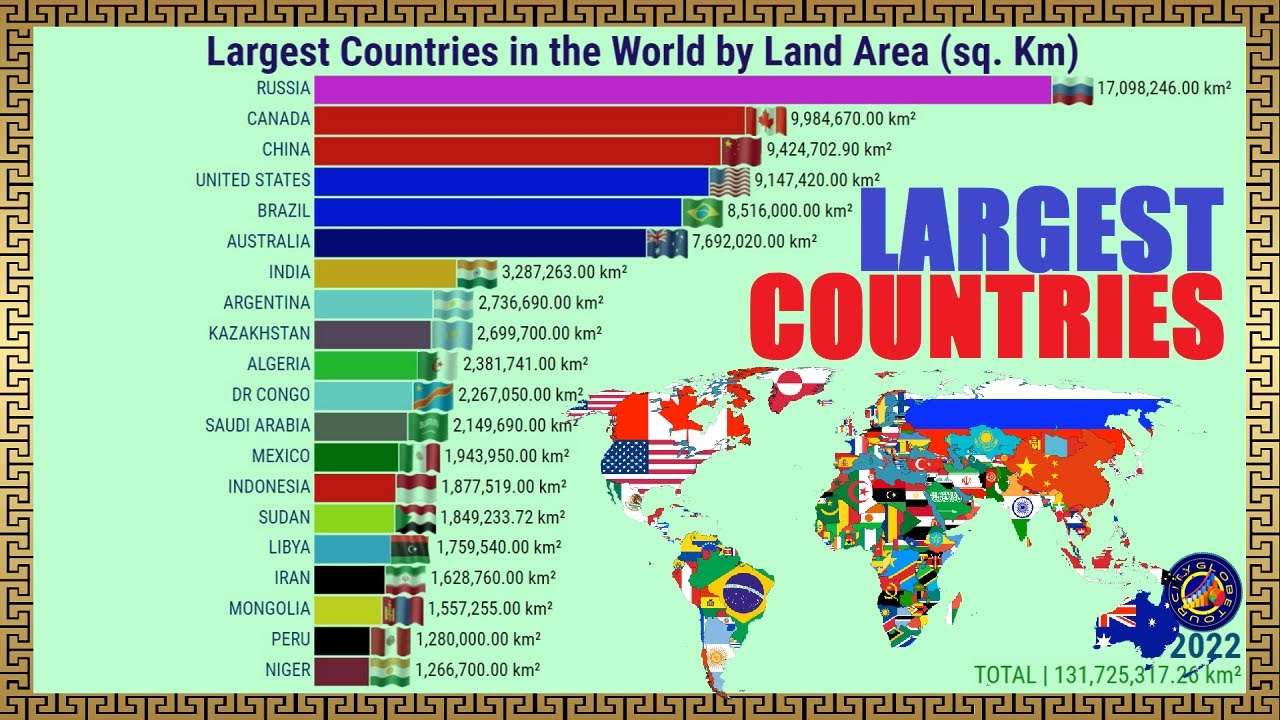
Russia’s landmass stands as a testament to sheer geographical grandeur, spanning over 17.1 million square kilometers (6.6 million square miles), making it the largest country on Earth. This expanse surpasses its closest rivals—Canada (9.98 million sq km) and China (9.6 million sq km)—by a margin that reshapes global cartography. The sheer scale of Russia’s territory influences climate zones, biodiversity, and human settlement patterns, while its geographical extremes create unique challenges in governance, infrastructure, and daily life.
Comparison of Russia’s Land Area with the World’s Top 5 Largest Countries

Russia’s dominance in size is not merely a matter of numbers but a reflection of its transcontinental reach, stretching across two continents (Europe and Asia) and encompassing 11 time zones. Below is a comparative analysis of the top 5 largest countries, illustrating how Russia’s land area dwarfs even its nearest competitors.
| Country Name | Land Area (sq km) | Land Area (sq mi) | Coastline Length (km) | Continent(s) |
|---|---|---|---|---|
| Russia | 17,098,246 | 6,601,670 | 37,653 | Europe, Asia |
| Canada | 9,984,670 | 3,855,100 | 202,080 | North America |
| China | 9,596,960 | 3,705,407 | 14,500 | Asia |
| United States | 9,372,610 | 3,618,780 | 19,924 | North America |
| Brazil | 8,515,767 | 3,287,953 | 7,491 | South America |
The disparity in coastline length further highlights Russia’s unique geography. While Canada boasts the longest coastline due to its extensive archipelago and fjords, Russia’s coastline includes the Arctic Ocean, Pacific Ocean, and Baltic Sea, adding strategic and ecological significance. This diversity in terrain—from the tundra of Siberia to the temperate forests of European Russia—contributes to its status as a megadiverse country, hosting over 2.5 million species, including endangered species like the Amur tiger and Siberian crane.
Territorial Divisions and Their Respective Sizes
Russia’s administrative structure comprises 85 federal subjects, categorized into republics, provinces (krais), territories (oblast), autonomous regions, and federal cities. This decentralized system ensures regional autonomy while maintaining national unity. Below is a breakdown of the 10 largest federal subjects by area, reflecting the country’s vastness and the challenges of governance across such a diverse landscape.
| Region | Type | Area (sq km) | Key Cities |
|---|---|---|---|
| Sakha Republic (Yakutia) | Republic | 3,083,523 | Yakutsk, Mirny |
| Krasnoyarsk Krai | Krai | 2,395,200 | Krasnoyarsk, Norilsk |
| Irkutsk Oblast | Oblast | 767,900 | Irkutsk, Bratsk |
| Kamchatka Krai | Krai | 472,300 | Petropavlovsk-Kamchatsky |
| Magadan Oblast | Oblast | 461,400 | Magadan |
| Amur Oblast | Oblast | 363,700 | Blagoveshchensk |
| Chukotka Autonomous Okrug | Autonomous Okrug | 737,700 | Anadyr |
| Zabaykalsky Krai | Krai | 431,900 | Chita |
| Khabarovsk Krai | Krai | 787,600 | Khabarovsk, Komsomolsk-on-Amur |
| Tomsk Oblast | Oblast | 316,900 | Tomsk, Seversk |
The Sakha Republic (Yakutia) alone is larger than India (3.29 million sq km) or Western Europe (5.1 million sq km combined), underscoring the scale of Russia’s remote regions. These areas often face harsh climates, limited infrastructure, and sparse populations, with some regions like Chukotka having a population density of less than 1 person per square kilometer. The federal subjects vary not only in size but also in ethnic composition, economic activity, and environmental conditions, necessitating tailored governance strategies.
Geographical Extremes and Their Impact on Climate, Biodiversity, and Human Habitation
Russia’s geographical extremes create a mosaic of climates and ecosystems, from the Arctic tundra in the north to the subtropical regions in the south. The northernmost point, Cape Chelyuskin (77°43′ N), lies within the Arctic Circle, where polar nights last for months and temperatures can plummet to -50°C (-58°F). In contrast, the southernmost point near Dagestan experiences a humid subtropical climate, with summer temperatures exceeding 40°C (104°F).
"Russia’s latitude-driven climate zones—ranging from tundra to steppe—dictate agricultural practices, energy demands, and even architectural designs. The permafrost in Siberia, covering 65% of the country, poses challenges for construction, while the southern regions support grain production critical to national food security."
The easternmost point near Dezhnev Cape (Chukotka) marks Russia’s Pacific frontier, where the Bering Strait separates Asia from North America. This region is home to indigenous Chukchi and Yupik communities, whose traditional livelihoods—such as reindeer herding and fishing—are increasingly threatened by climate change and industrial development. Meanwhile, the westernmost point in Kaliningrad, an exclave bordered by Poland and Lithuania, reflects Russia’s unique geopolitical position in Europe.
Biodiversity in these extremes is equally striking. The tund
Historical Evolution: How Russia Became the Largest Country
Russia’s transformation into the world’s largest country was not an accident but the result of deliberate expansionist policies spanning over a millennium. From the medieval Kievan Rus’ to the modern Russian Federation, territorial growth was driven by military conquests, strategic alliances, and the relentless push eastward into Siberia. Each dynasty and leader contributed uniquely to this expansion, shaping Russia’s borders through a mix of brute force, diplomacy, and economic exploitation. The legacy of these strategies—some aggressive, others pragmatic—remains embedded in Russia’s geopolitical identity today.
Key Dynasties and Rulers Shaping Territorial Expansion
Russia’s expansion was marked by distinct phases under influential rulers, each employing different tactics to reshape the country’s boundaries. Below is a comparative analysis of major dynasties and their contributions to territorial growth, structured to highlight their methods and long-term impacts.
| Period | Key Actions | Territories Gained | Impact on Size |
|---|---|---|---|
| 9th–13th Century (Kievan Rus’) | Trade alliances, Viking-led expansion, Christianization under Vladimir the Great (988 AD) | Northern trade routes, Kyiv, Novgorod | Established early territorial foundations; fragmented after Mongol invasions (1240) |
| 15th–16th Century (Ivan III & Ivan IV) | Centralization of power, defeat of Mongols (1480), conquest of Kazan (1552) and Astrakhan (1556) | Volga River basin, Siberia’s gateway regions | Doubled territorial control; Ivan IV (the Terrible) expanded into Siberia via Cossack expeditions |
| Late 17th–18th Century (Peter the Great) | Great Northern War (1700–1721), founding of St. Petersburg (1703), expansion into Baltic and Black Sea regions | Baltic coast (Finland, Estonia, Latvia), access to Black Sea | Shifted focus to Europe; secured warm-water ports for trade and military |
| Mid-18th Century (Catherine the Great) | Partitions of Poland (1772–1795), Crimean annexation (1783), Russo-Turkish Wars | Crimea, Ukraine, Belarus, parts of modern Poland and Lithuania | Peak of imperial expansion; Russia became a European powerhouse |
| 20th Century (Stalin & Soviet Era) | Forced resettlements (e.g., deportations to Siberia), annexations post-WWII (1939–1940), Cold War-era territorial disputes | Baltic states, parts of Eastern Europe, Central Asia | Consolidated Soviet Union’s vast borders; post-1991, Russia inherited 75% of USSR’s territory |
Russia’s expansion strategies varied significantly between leaders. Peter the Great prioritized Western expansion, focusing on securing ports and modernizing the military to compete with Europe. His conquests in the Baltic and Black Sea regions were as much about geopolitical leverage as they were about economic access. In contrast, Catherine the Great shifted focus southward, annexing Crimea and expanding into the Black Sea. Her approach was less about military aggression and more about diplomatic maneuvering and strategic alliances, particularly with the Ottoman Empire.
Peter the Great’s expansion was driven by a mirroring of Europe—acquiring territory to project Russia as a Western power, while Catherine the Great’s conquests were rooted in imperial ambition and resource control, particularly agricultural lands in Ukraine and Crimea.
Post-Soviet Territorial Changes and Geopolitical Shifts
The dissolution of the Soviet Union in 1991 did not mark the end of Russia’s territorial evolution but rather a redefinition of its borders. Since then, Russia has faced both losses and gains, often accompanied by international scrutiny. Below is a timeline of critical events that reshaped Russia’s modern geography.
| Year | Event | Territories Involved | International Reactions |
|---|---|---|---|
| 1991 | Dissolution of the USSR | 15 republics gained independence; Russia inherited 75% of Soviet territory | Global recognition of new states; NATO expansion concerns emerged |
| 2008 | Russo-Georgian War | Abkhazia and South Ossetia (de facto annexation) | Condemnation by UN; strained Russia-West relations |
| 2014 | Annexation of Crimea | Crimea (from Ukraine) | Sanctions from US/EU; suspension of Russia from G8 |
| 2022 | Full-scale invasion of Ukraine | Donetsk, Luhansk, Kherson, Zaporizhzhia (partial control) | Massive sanctions; global isolation; NATO enlargement accelerated |
These post-Soviet changes reflect Russia’s dual strategy of territorial consolidation and geopolitical provocation. While the loss of Central Asian republics (e.g., Kazakhstan, Uzbekistan) was irreversible, actions like Crimea’s annexation demonstrated Russia’s willingness to use force to reclaim perceived historical territories. The 2022 invasion of Ukraine further exposed Russia’s expansionist ambitions, albeit at a significant economic and diplomatic cost.
Siberia: The Backbone of Russia’s Eastern Expansion
Siberia’s role in Russia’s growth cannot be overstated. Stretching across 77% of Russia’s landmass, this region was transformed from a sparsely populated wilderness into a strategic and economic powerhouse through forced migration, infrastructure projects, and resource exploitation. Two key factors—the Trans-Siberian Railway and Stalin’s forced resettlements—were instrumental in shaping Siberia’s modern identity.
The Trans-Siberian Railway (1891–1916), spanning 9,288 kilometers, was more than a logistical marvel; it was a tool of imperial control. By connecting Moscow to Vladivostok, the railway enabled rapid military deployment, facilitated the export of Siberian resources (coal, gold, timber), and encouraged mass migration. Cities like Novosibirsk emerged as industrial hubs, while remote regions became accessible for exploitation.
The Trans-Siberian Railway was not just a railway—it was a lifeline for Russia’s eastern conquest, turning Siberia from an impenetrable frontier into the country’s economic heartland.
Stalin’s policies further accelerated Siberia’s development, albeit through coercion. The Great Terror (1937–1938) saw entire ethnic groups (e.g., Chechens, Tatars, Koreans) deported to Siberia under the guise of "resettlement." While this was a brutal chapter in Russian history, it also dramatically increased Siberia’s population, with cities like Tomsk and Irkutsk becoming administrative centers for the Gulag system. By the mid-20th century, Siberia accounted for 20% of the USSR’s GDP, primarily from mining, oil, and gas extraction.
Urban Centers: From Trade Hubs to Expansionist Pillars
Russia’s largest cities evolved from trade outposts and military strongholds into economic and political engines that both facilitated and resisted territorial expansion. Each city’s trajectory reflects broader imperial strategies and regional dynamics.
Moscow, founded in the 12th century, became the symbol of Russian statehood under Ivan III and Ivan IV.
Demographics: Population Distribution Across Russia’s Vast Territories
Russia’s population distribution reflects a stark contrast between its densely populated European core and the sparsely inhabited Siberian and Far Eastern regions. With a total area of 17.1 million sq km, the country’s population density—averaging 9.1 people per sq km—is among the lowest globally, shaped by geographical barriers, climate extremes, and historical settlement patterns. Understanding these disparities is crucial for analyzing regional development, economic disparities, and migration dynamics within the world’s largest nation.
Population Density and Urbanization: Russia Compared to Other Large Countries
Russia’s population distribution differs significantly from other major countries, particularly in terms of density and urban concentration. The following table compares Russia with Canada, China, and the USA, highlighting key demographic metrics:
| Country | Total Population (2023 est.) | Population Density (people/sq km) | Urban Population (%) | Major Metropolitan Areas |
|---|---|---|---|---|
| Russia | 144.4 million | 9.1 | 74.5% | Moscow (12.6M), St. Petersburg (5.4M), Novosibirsk (1.6M) |
| Canada | 38.8 million | 4.3 | 81.9% | Toronto (6.4M), Vancouver (2.6M), Montreal (4.3M) |
| China | 1.41 billion | 153.0 | 64.0% | Shanghai (29.2M), Beijing (21.5M), Shenzhen (17.5M) |
| USA | 339.9 million | 36.5 | 83.2% | New York (20.1M), Los Angeles (13.2M), Chicago (9.5M) |
Russia’s low density stems from its vast, often inhospitable territories, while its urbanization rate (74.5%) is slightly below the global average (56.2%) but comparable to other developed nations. However, unlike the USA or Canada, where urban centers are distributed along coastlines or trade routes, Russia’s population is heavily concentrated in the western European region, with 75% of the population living west of the Urals.
Challenges in Sparsely Populated Regions: Yakutia and Chukotka
The Russian Far East and Siberia, including regions like Yakutia (Sakha Republic) and Chukotka, face severe demographic challenges due to extreme climates, isolation, and economic hardships. Population density in Yakutia, for example, is 0.5 people per sq km, while Chukotka’s density drops to 0.1 people per sq km—among the lowest in the world. These regions experience: - Harsh climatic conditions: Temperatures in Yakutia can plummet to -60°C (-76°F), while Chukotka’s coastal areas endure prolonged darkness and Arctic winds. - Limited infrastructure: Remote settlements lack reliable transportation, healthcare, and modern utilities, exacerbating outmigration. - Economic dependency: Local economies rely on extractive industries (gold, diamonds, oil) or subsidies, offering few stable job opportunities.
To counteract depopulation, the Russian government has implemented incentives such as: - Cash bonuses for families relocating to the Far East (up to ₽5 million or ~$65,000 for those moving permanently). - Tax exemptions for businesses operating in these regions. - Subsidized housing and public sector jobs to attract skilled labor.
"The Far East’s depopulation is a ticking time bomb. Without sustained investment and incentives, Russia risks losing control over strategic territories, including those bordering China and the Pacific. The government’s ‘Far East Hegemony’ project, offering land grants and citizenship perks, remains a stopgap measure rather than a long-term solution." — Russian Demographic Research Institute, 2022
Federal District Disparities: Population and Economic Activity
Russia’s 11 federal districts exhibit dramatic variations in population density and economic output, with the European region dominating both metrics. The following table illustrates these disparities:
| District Name | Population (2023 est.) | Area (sq km) | Population Density (people/sq km) | Key Industries |
|---|---|---|---|---|
| Central Federal District | 39.9 million | 650,000 | 61.4 | Manufacturing, finance, agriculture, energy |
| Northwestern Federal District | 14.2 million | 1.7 million | 8.4 | Shipping, petrochemicals, shipbuilding |
| Siberian Federal District | 19.3 million | 5.2 million | 3.7 | Oil/gas, mining, hydroelectric power |
| Far Eastern Federal District | 6.4 million | 6.2 million | 1.0 | Fishing, timber, military logistics |
The Central Federal District, home to Moscow and St. Petersburg, accounts for 28% of Russia’s population despite covering only 4% of its land area. In contrast, the Far Eastern District, spanning 36% of Russia’s territory, holds just 4.4% of the population. This imbalance underscores the resource curse: while Siberia and the Far East are rich in natural resources, their potential remains underutilized due to logistical and demographic constraints.
Migration Patterns: Internal and External Movements
Russia’s population dynamics are shaped by both internal migration (urbanization and rural-to-city movements) and external migration (labor inflows and emigration). These trends have profound social and economic consequences.
Internal Migration: - Urbanization surge: Since the 1990s, over 25 million Russians have moved from rural areas to cities, driven by job opportunities and declining agricultural incomes. Moscow and St. Petersburg alone attract net annual migration of 300,000–500,000 people, straining infrastructure and housing markets. - Regional disparities: The Volga Federal District and Ural Federal District act as secondary hubs, attracting migrants from Central Russia and the Caucasus, while Siberia and the Far East continue to lose residents.
External Migration: - Labor migrants: Russia hosts ~11 million migrant workers, primarily from Central Asia (Uzbekistan, Tajikistan, Kyrgyzstan), who fill gaps in construction, agriculture, and domestic services. These workers remit ~$15 billion annually to their home countries, a critical source of foreign exchange for Central Asian economies. - Brain drain and emigration: Since the 2014 Ukraine crisis, ~1 million Russians have emigrated, with 300,000–500,000 annually leaving due to economic stagnation, political repression, and sanctions. IT professionals, scientists, and healthcare workers are the most affected, exacerbating skill shortages in critical sectors.
*"The dual migration crisis—rural depopulation and skilled emigration—threatens Russia’s long-term competitiveness. While labor migrants prop up low-wage sectors, the exodus
Economic and Resource Advantages of Russia’s Vast Territory
Russia’s immense geographical expanse transforms it into a global powerhouse of natural resources, offering unparalleled economic leverage. With 11 time zones and 17 million square kilometers, the country holds nearly 20% of the world’s fresh water, 23% of its forest cover, and 25% of its arable land. These resources are not merely scattered but strategically concentrated in regions that dominate critical industries—from energy exports to agriculture. The economic advantages stem from the diversity of deposits, infrastructure connectivity, and geopolitical control over supply chains, positioning Russia as a key player in global commodity markets. However, harnessing these advantages requires overcoming logistical hurdles, climate constraints, and regional disparities in development.
Russia’s Natural Resources: Distribution and Economic Contribution
Russia’s wealth lies beneath its surface and within its forests, with reserves that rival those of the entire Middle East combined. The country’s resource distribution is highly regionalized, creating economic hubs that drive national and global markets. Below is a breakdown of the top natural resources, their primary locations, production/reserves, and their contribution to the GDP (as of recent data from Rosstat, BP Statistical Review, and FAO).
Resource Major Deposits/Locations Annual Production/Reserves (2023 Estimates) Economic Contribution (%) to GDP Crude Oil Western Siberia (Tyumen Region), Eastern Siberia (Irkutsk, Krasnoyarsk), Arctic (Pechora Basin) 530 million tons (10.6 million barrels/day); Proven reserves: 80 billion barrels (8% of global) ~5.5% Natural Gas Yamal Peninsula (Novatek, Gazprom), Western Siberia (Medvezhye, Urengoy), Arctic (Gydan Peninsula) 718 billion cubic meters (2023); Proven reserves: 47.8 trillion cubic meters (18% of global) ~7.2% Coal Kuzbass (Kemerovo), Yakutia (Lena Basin), Pechora Basin (Republic of Komi) 450 million tons (2023); Reserves: 167 billion tons (10% of global) ~1.8% Diamonds Yakutia (Mirny, Udachny, Aikhal mines), Arkhangelsk Region (Lovozero) 42 million carats (2023); Reserves: 800 million carats (25% of global) ~0.5% (high-value niche market) Timber Siberia (Krasnoyarsk, Irkutsk), Far East (Khabarovsk, Primorsky Krai), European North (Arkhangelsk) 200 million cubic meters (2023); Forest cover: 8.5 million km² (20% of global) ~1.2% Potash Fertilizers Berezniki (Perm Krai), Solikamsk (Perm Krai), Verkhnekamskoe deposit 25 million tons (2023); Reserves: 1.3 billion tons (20% of global) ~2.1% Nickel and Palladium Norilsk (Krasnoyarsk Krai), Talnakh, Monchegorsk (Murmansk) 280,000 tons nickel; 85 tons palladium (2023); Reserves: Nickel (10M tons), Palladium (100M oz) ~1.5% The energy sector (oil and gas) alone accounts for over 12% of GDP, while minerals like palladium—critical for automotive catalysts—give Russia a monopoly-like control over global supply chains. The Arctic region, with its untapped oil and gas fields, is projected to contribute $100 billion annually by 2035, according to the Russian Ministry of Natural Resources. However, extraction in these remote areas faces environmental and technical challenges, including permafrost thawing and infrastructure limitations.
Regional Economic Sectors: Industry Distribution and Government Policies
Russia’s economic landscape is highly regionalized, with each territory specializing in industries that align with its natural endowments. Below is a regional breakdown of dominant sectors, key players, and government initiatives fostering growth.
Region Dominant Industry Key Companies/Exports Government Policies Supporting Growth Western Siberia (Tyumen, Khanty-Mansi) Oil and Gas Extraction Gazprom, Rosneft, Lukoil; 70% of Russia’s oil, 90% of gas Tax incentives for Arctic exploration, Far East and Arctic Development Strategy (2020–2035) Ural Federal District (Yekaterinburg, Chelyabinsk) Heavy Industry, Metallurgy Magnitogorsk Iron & Steel, Uralkali (potash), Uralvagonzavod (armaments) Subsidies for machinery exports, Ural Industrial Way program Far East (Vladivostok, Khabarovsk) Agriculture, Timber, Port Logistics Dallesprom (timber), Primorskaya GRES (energy), Free Port of Vladivostok Far East Hegemony (tax breaks, land grants for businesses), Trans-Siberian Railway upgrades European North (Murmansk, Arkhangelsk) Shipping, Mining (Nickel, APL), Fisheries Norilsk Nickel, Severstal, Murmansk Shipping Company Arctic Zone Development Fund, Northern Sea Route subsidies Volga Federal District (Kazan, Nizhny Novgorod) Automotive, Aerospace, Chemicals KAMAZ (trucks), Kazan Helicopters, Sibur (petrochemicals) Volga Cluster for high-tech manufacturing, state contracts for defense industries Siberia (Novosibirsk, Krasnoyarsk) Energy, Aluminum, Agriculture RUSAL (aluminum), Irkutsk Oil Company, Siberian Wheat exports Siberian Federal District Development Strategy, rail electrification projects The Far East and Arctic regions are priorities under President Putin’s "Far East Hegemony" policy, offering tax holidays, land grants, and infrastructure subsidies to attract investors. Meanwhile, the Ural region remains the backbone of Russia’s industrial might, producing 40% of its machinery and metals. However
Geopolitical Implications of Russia’s Vast Territorial Dominance
Russia’s unprecedented geographical scale transforms it into a linchpin of global geopolitics, reshaping trade dynamics, military strategy, and diplomatic alliances. With landmasses spanning two continents and coastlines bordering the Arctic, Pacific, and Baltic, the country’s size grants it unparalleled control over critical transit corridors, natural resources, and strategic chokepoints. These assets position Russia as a decisive player in shaping the 21st-century geopolitical landscape, though they also impose formidable governance challenges and amplify tensions with neighboring states. The country’s territorial expanse enables it to leverage its position as a land bridge between Europe and Asia, a role that has historically underpinned its economic and military influence. Beyond land-based connectivity, Russia’s Arctic territories and northern sea routes are emerging as pivotal arteries for global commerce, while its control over energy pipelines and transit hubs—such as the Northern Sea Route (NSR) and Trans-Siberian Railway—further solidifies its geoeconomic leverage. However, this dominance is contested, with rival powers and regional actors challenging Russia’s sovereignty, territorial integrity, and resource monopolies.
Strategic Land Bridges and Maritime Corridors
Russia’s geographical advantages extend beyond its sheer size, encompassing its ability to dominate transcontinental transit routes that connect Europe to Asia. The Trans-Siberian Railway, the world’s longest railway line, stretches over 9,288 kilometers, linking Moscow to Vladivostok and serving as a critical infrastructure link for trade between China and Europe. Complementing this, the BAM Railway (Baikal-Amur Mainline) provides an alternative northern route, reducing reliance on the more congested southern corridors. Maritime corridors further amplify Russia’s strategic importance. The Northern Sea Route (NSR), a shortcut between Europe and Asia via the Arctic, is projected to become a primary Arctic shipping lane as ice melt accelerates. By 2030, the NSR could reduce shipping distances between Rotterdam and Yokohama by 40%, offering Russia a competitive edge in global logistics. Additionally, Russia’s control over the Black Sea, Baltic Sea, and Pacific Ocean allows it to project naval power across Eurasia, reinforcing its status as a maritime and terrestrial powerhouse.
Asset Location Global Significance Current Conflicts/Disputes Trans-Siberian Railway Moscow to Vladivostok (Russia) Primary Eurasian land transit route; connects China to Europe, reducing dependency on Suez Canal. China’s Belt and Road Initiative (BRI) competes for dominance; sanctions limit modernization efforts. Northern Sea Route (NSR) Arctic Ocean (Russia’s northern coast) Emerging Arctic shipping lane; could slash Asia-Europe transit times by up to 30%. Territorial disputes with Norway and Denmark (Greenland); U.S. and NATO monitor militarization. Black Sea Fleet Sevastopol (Crimea) and Novorossiysk Strategic naval base for Mediterranean and Middle East operations; critical for Russian influence in Syria. Ukraine’s sovereignty claims over Crimea; NATO expansion in Black Sea region. TurkStream Gas Pipeline Russia to Turkey via Black Sea Bypasses Ukraine, securing Europe’s gas supply; reduces EU energy dependence on transit states. EU sanctions on Nord Stream 2 spillover; Ukraine’s opposition to Russian energy dominance. Russia’s energy export routes further cement its geopolitical influence. Pipelines such as Nord Stream 1 and 2 (to Europe) and Power of Siberia (to China) allow Moscow to weaponize energy supplies, leveraging gas as a diplomatic and economic tool. The Sovcomflot, Russia’s state-owned shipping company, dominates Arctic logistics, while the Far Eastern ports of Vladivostok and Nakhodka serve as gateways for trade with East Asia. These assets collectively position Russia as an indispensable node in the global supply chain, though their effectiveness is increasingly contested by rival infrastructure projects, such as China’s China-Europe Railway Express and the Icebreaker Modernization Program led by Norway and Finland.
Arctic Sovereignty and Geopolitical Rivalries
Russia’s Arctic policy is defined by a dual strategy of territorial expansion and economic exploitation, contrasting sharply with the more cautious approaches of other Arctic Council members. While the U.S., Canada, and Norway prioritize multilateral cooperation under the Arctic Council, Russia has pursued an assertive unilateral agenda, reinforcing its claims to vast Arctic territories and militarizing the region.
Policy Focus Russia USA Canada Norway Territorial Claims Extends claims to Northern Sea Route (NSR); disputes with Norway (Svalbard, Barents Sea). Challenges Russian Arctic militarization; supports Indigenous rights (e.g., Alaska Natives). Asserts sovereignty over Arctic Archipelago; opposes Russian NSR dominance. Challenges Russia’s Lomonosov Ridge claim; focuses on Svalbard and Barents Sea. Military Presence 10 Arctic military bases (e.g., Severny Polyus, Tiksi); nuclear-capable Borei-class submarines. Thule Air Base (Greenland); Arctic Strategy 2013 emphasizes deterrence. Joint Task Force North; patrols Canadian Arctic Archipelago. Arctic Command (NORARCOM); cooperates with NATO on monitoring. Climate Change Opportunities Exploits melting ice for NSR expansion; plans Arctic LNG 2 by 2024. Supports Arctic Council science initiatives; opposes Russian monopolization. Develops Northern Canadian routes; prioritizes Indigenous consultation. Invests in clean energy Arctic shipping; challenges Russian dominance. Economic Priorities Resource extraction (oil, gas, minerals); state-backed Rosneft, Gazprom. Offshore drilling (Chukchi Sea); private sector-led exploration. Diamonds, rare earth minerals; government-subsidized Arctic shipping. Hydrocarbons (Barents Sea); sustainable Arctic tourism. Russia’s Arctic ambitions are encapsulated in its "Arctic Doctrine 2020", which frames the region as a priority for national security and economic development. The doctrine emphasizes:
Militarization: Establishment of Severny Polyus, Russia’s first floating nuclear-powered icebreaker fortress, capable of projecting power across the Arctic. Resource Control: Acceleration of oil and gas extraction in the Pechora Basin and Yamal Peninsula, with plans to expand Arctic LNG exports by 2030. Legal Aggression: Rejection of UN Convention on the Law of the Sea (UNCLOS) rulings unfavorable to Russia, such as the 2015 rejection of Norway’s Svalbard claims. "The Arctic is a zone of our country’s privileged interests. This is a strategic resource base, a huge economic potential, and a factor ensuring the country’s security." — Vladimir Putin, 2020 Arctic Security Address
In contrast, the U.S. Arctic Strategy focuses on deterrence and scientific cooperation, while Canada’s Arctic Sovereignty Action Plan prioritizes military patrols and Indigenous rights. Norway, though
Cultural and Environmental Diversity Across Russia
Russia’s vast expanse is not merely a geographical marvel but a living tapestry of ethnic diversity, cultural traditions, and ecological richness. Stretching across two continents, the country harbors over 190 distinct ethnic groups, each contributing to a mosaic of languages, religions, and customs. This diversity is mirrored in its ecosystems, which range from Arctic tundras to subtropical forests, supporting unique flora and fauna. However, this richness faces mounting pressures from industrialization, climate change, and assimilation policies, creating a delicate balance between preservation and development.
Ethnic Diversity and Geographical Concentrations
Russia’s ethnic composition reflects centuries of migration, conquest, and cultural exchange. The majority ethnic group, Russians, constitutes approximately 77% of the population, predominantly concentrated in European Russia and the Urals. However, indigenous peoples and minority groups inhabit the peripheral regions, often preserving distinct identities despite Russian influence. Below is an overview of key ethnic groups, their geographical concentrations, and cultural characteristics.
Ethnic Group Population (approx.) Primary Regions Languages/Cultures Historical Background Russians 110 million European Russia, Siberian cities (e.g., Novosibirsk, Yekaterinburg) Russian (official), Orthodox Christianity Slavic migration from the 9th century; expansion under Kievan Rus’, Mongol influence, and later imperial policies consolidated dominance. Tatars 5.5 million Volga region (Republic of Tatarstan), Bashkortostan Tatar (Turkic), Islam (Sunni) Golden Horde descendants; played pivotal roles in trade and diplomacy under Russian rule while maintaining cultural autonomy. Ukrainians 2 million Southern Federal District (Rostov, Krasnodar), Crimea Ukrainian (Cyrillic script), Eastern Orthodox/Uniate Christianity Shared history with Russia; industrialization and Soviet policies led to assimilation, though distinct identity persists. Bashkirs 1.3 million Republic of Bashkortostan (Ural Mountains) Bashkir (Turkic), Islam (with shamanist influences) One of Russia’s oldest Turkic groups; resisted Mongol and Russian expansion but later integrated through Soviet policies. Chukchi 15,000 Chukotka Autonomous Okrug (Far East) Chukchi (Chukotko-Kamchatkan), Shamanism/Orthodox Christianity Indigenous reindeer herders and hunters; faced forced collectivization under the USSR and modern environmental threats. Buryats 450,000 Buryatia (Siberia), Irkutsk Oblast Buryat (Mongolic), Tibetan Buddhism Mongol descendants; preserved Buddhist traditions despite Soviet atheist campaigns; now experience cultural revival. The interplay between these groups and the Russian majority has often been marked by both cooperation and conflict. For instance, the Cossacks, predominantly in the Don and Kuban regions, embody a unique blend of Slavic and steppe cultures, known for their military traditions and resistance to central authority.
"The Cossacks were never just a military caste; they were a society of free men, bound by their own laws and traditions, who saw Russia as both an ally and an oppressor." — Historian Richard Hellie, "The Cossacks: A History"
In contrast, indigenous groups like the Evenki of Siberia or the Nenets of the Arctic face erasure through forced relocation and economic marginalization. The Soviet era’s policy of "cultural assimilation" systematically suppressed minority languages, with over 100 languages disappearing entirely since the 1930s.
Distinct Cultural Regions and Their Traditions
Russia’s cultural landscape is fragmented into distinct regions, each shaped by geography, climate, and historical isolation. These regions often resist homogenization, preserving traditions that contrast sharply with mainstream Russian culture.
The Cossack Regions (Don, Kuban, Terek) Cossack culture is rooted in the steppe, emphasizing horsemanship, martial prowess, and communal governance. Festivals like Pamyat Zaporozhskogo Kazaka (Day of the Cossack) celebrate their legacy, while krugovaya poruka (circle of responsibility) reflects their collective justice system.
"A Cossack without a horse is like a bird without wings." — Cossack proverb
Buryatia and the Buddhist Influence Located in southern Siberia, Buryatia is the heart of Tibetan Buddhism in Russia. The Ivolginsky Datsan, the largest Buddhist monastery in Europe, attracts pilgrims and preserves ancient scriptures. The Sagaalgan Festival, marking the beginning of the lunar year, features masked dances and offerings to spirits.
Chukotka: The Land of the Extreme North The Chukchi people of Chukotka maintain a semi-nomadic lifestyle, relying on reindeer herding and marine mammal hunting. Their Yanraamyte festival celebrates the New Year with shamanic rituals and feasts, though modernization threatens these traditions.
"Our land is not just ice and snow—it is the breath of the earth, the voice of our ancestors." — Chukchi elder, as recorded in "Indigenous Peoples of the Russian North"
The North Caucasus: A Melting Pot of Cultures This region blends Turkic, Circassian, and Slavic influences. The Nart sagas of the Chechens and Ingush recount mythical heroes, while kizgach (traditional hospitality) remains a cornerstone of social life. However, conflicts with Russian assimilation policies have led to violent clashes, particularly in Chechnya.
Biodiversity and Protected Ecosystems
Russia’s size enables the coexistence of some of the world’s most diverse ecosystems, from the Arctic tundra to the subtropical forests of the Caucasus. These regions support unique species, many of which are endangered due to human activity. Below are key protected areas and their ecological significance.
Reserve Name Type Size (sq km) Key Species Threats Lake Baikal UNESCO World Heritage Site, Biosphere Reserve 1,642 (lake) / 4,300 (reserve) Baikal seal, omul fish, 1,700+ endemic species Pollution from pulp mills, climate change, illegal fishing Wrangel Island UNESCO World Heritage Site, Nature Reserve 7,950 Walrus, polar bear, migratory birds (e.g., ivory gull) Oil exploration, melting permafrost, invasive species Altay Golden Mountains UNESCO Biosphere Reserve 1,650 Snow leopard, argali sheep, Siberian ibex Deforestation, mining, poaching Kronotsky Reserve National Park Russia’s status as the largest country in the world is not just a matter of landmass but a testament to its resilience, contradictions, and global significance. From the frozen steppes of Siberia to the bustling streets of Moscow, its extremes—geographical, cultural, and economic—demand constant adaptation. As climate change reshapes its Arctic frontiers and energy dependencies fuel international tensions, Russia’s vastness remains both its greatest asset and most formidable challenge. The story of this land is far from over; it is a living, evolving narrative where every square kilometer carries layers of history, ambition, and survival.
Leave a Comment
Comments are moderated before appearing. The data you submit is processed according to the Privacy Policy of Refer.